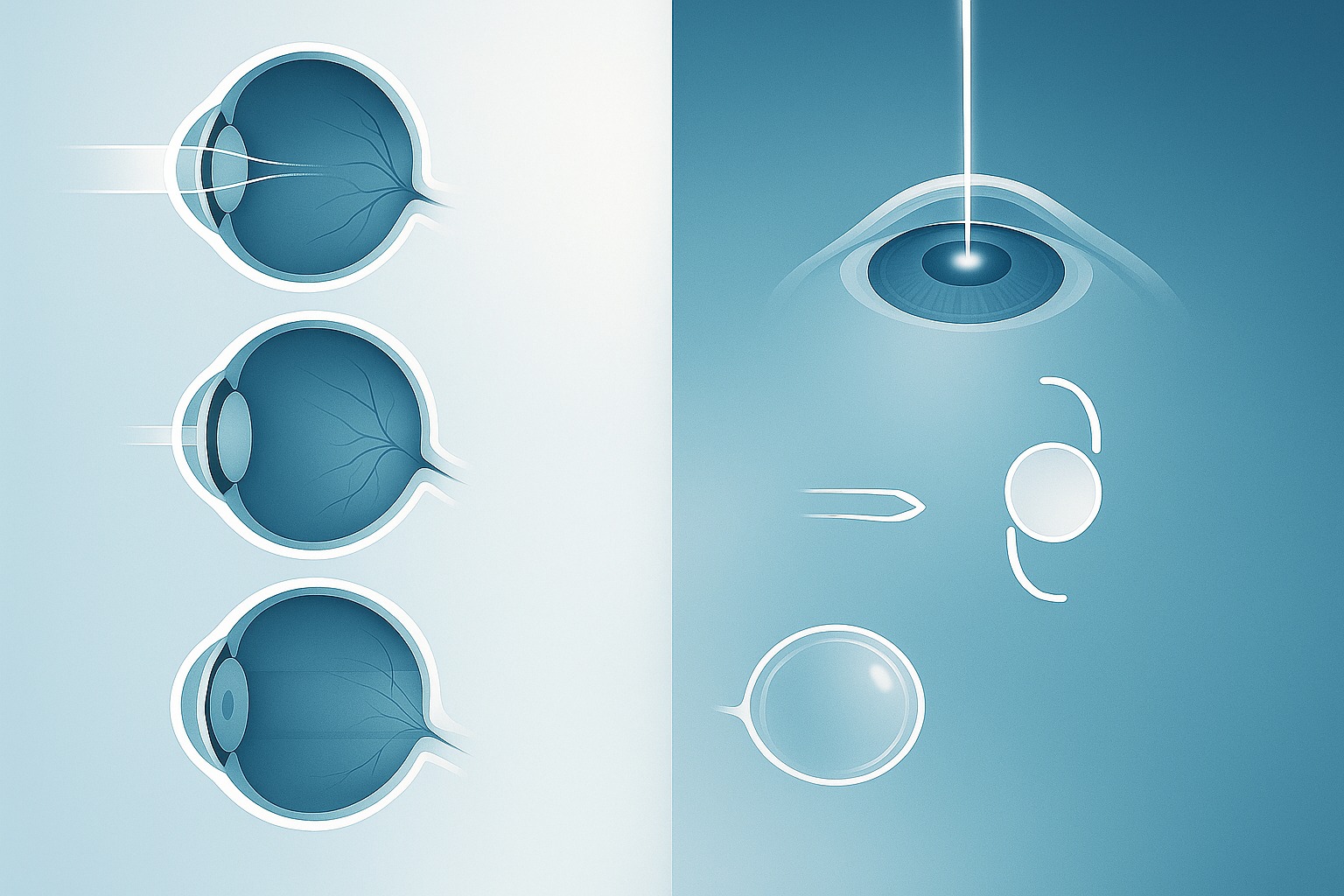
Hyperopia (farsightedness): Close objects appear blurry.
Astigmatism: Distorted or blurred vision at all distances due to an irregularly shaped cornea or lens.
Presbyopia: Age-related difficulty in focusing on close objects.
Refractive Surgery:
Refractive surgery aims to correct these errors by reshaping the cornea or modifying the eye’s focusing ability. Common procedures include:
Femto-LASIK (Femtosecond Laser-Assisted In Situ Keratomileusis): A flap is created in the cornea, and a laser reshapes the underlying tissue. Quick recovery, minimal discomfort, suitable for many patients.
PRK (Photorefractive Keratectomy): The cornea’s surface layer is removed and reshaped with a laser. Slower recovery than LASIK but suitable for thinner corneas.
KLEx (Keratorefractive Lenticule Extraction): A small piece of corneal tissue is removed through a tiny incision. Less invasive, potentially less dry eye risk than LASIK.
Lens-Based Surgery: Refractive Lens Exchange (RLE): Replaces the natural lens with an artificial one, similar to cataract surgery. Phakic Intraocular Lens (IOL): An implantable lens added without removing the natural lens, often used for high myopia.
Considerations:
Not everyone is a candidate; suitability depends on corneal thickness, eye health, and vision stability.
Potential risks include dry eyes, halos, under- or over-correction, and rare complications.

Comments are closed.